
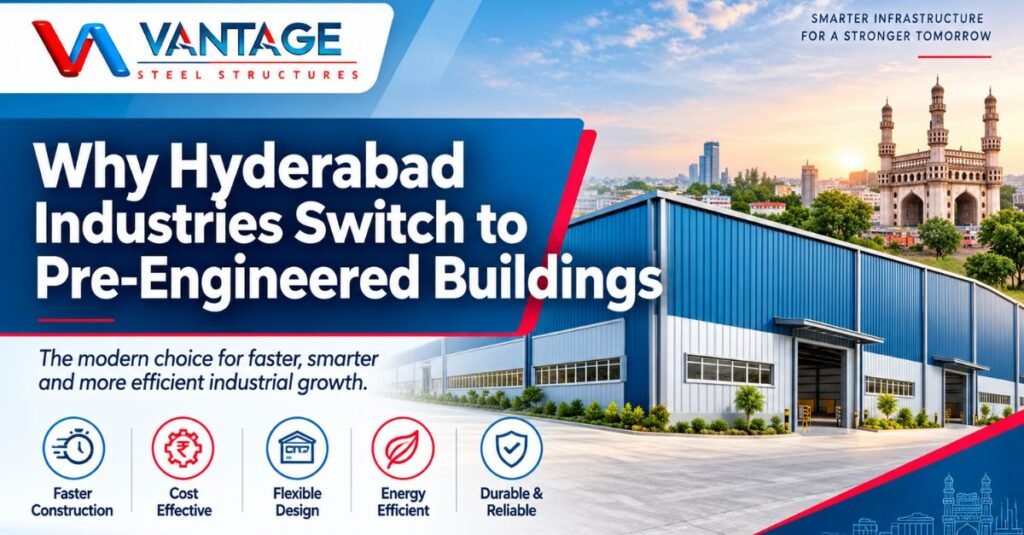
Why Hyderabad Industries Are Switching to Pre-Engineered Buildings
Drive through Jeedimetla, Patancheru or Shamshabad today and you will notice a pattern. More and more factories and warehouses are going up in steel. The long, clean roofline of a pre-engineered building (PEB) is becoming the norm.
Hyderabad’s industrial belts keep widening. Logistics parks are spreading near the ORR. Pharma units are growing around Genome Valley and Pashamylaram. Showrooms and service centres are opening along main roads. All of them need large, flexible buildings, built quickly.
This is not a passing trend. Industries in Hyderabad want to open sooner, spend wisely and leave room to grow. PEB helps with all three. Here is why so many businesses are making the switch.
Faster Construction Is Driving the Shift to Pre-Engineered Buildings
Time is money for any industrial project. Every month of delay is a month without output or rent income. This is where PEB stands out.
Parts Made Before They Reach the Site
In a PEB, steel members are designed and cut in a factory. They arrive on site ready to bolt together. Foundation work and fabrication can run side by side, so the schedule gets shorter. Conventional RCC needs curing time for each stage. Steel does not.
Fewer Weather Delays
Hyderabad’s monsoon can stall site work for days. Since most of the work happens indoors at the factory, rain affects the timeline far less. Erection on site is quicker and cleaner.
Earlier Returns on Investment
A unit that opens earlier starts earning earlier. For a new plant, earlier production means orders delivered sooner. That head start often outweighs small differences in upfront price.
Lower and More Predictable Project Costs
Cost is the next big reason. A PEB is not always the cheapest on day one, but the full picture is often better.
Efficient Use of Steel
Engineers design each frame for the exact loads it will carry. Thicker steel goes where it is needed and lighter sections go elsewhere. Less waste means lower material cost.
Lower Labour and Site Costs
A shorter site programme needs fewer workers for fewer days. Site supervision, equipment hire and power costs drop with it. Costs are also easier to predict because the design is fixed early.
Simple Expansion Later
Business grows. A PEB can be extended by adding bays at the end of the building. You do not need to demolish anything. This protects your original investment.
Strength and Flexibility for Hyderabad’s Industries
Steel is strong for its weight. A well-designed PEB can carry wind loads, cranes and heavy equipment while keeping the floor open.
Comfort in a Hot Climate
Summers here are tough on metal roofs. Insulated roof and wall panels, ventilators and skylights keep the inside cooler and brighter. That helps workers, stored goods and electricity bills.
Durability With Low Maintenance
Steel does not rot or attract termites. With proper coating and basic upkeep, a PEB can serve for decades. Many owners find yearly maintenance is limited to checking fasteners, sheets and gutters.
A Greener Choice
Steel is recyclable, and factory production creates less waste on site. For companies with sustainability goals, that is a useful advantage.
Industries Making the Switch
PEB suits a wide range of uses:
- Warehousing and Logistics: Large open floors for racking, forklifts and fast loading near the ORR.
- Manufacturing: Wide spans for production lines, with crane support where needed.
- Pharma and Food Processing: Insulated, controlled spaces around Pashamylaram and Genome Valley.
- Retail and Showrooms: Bright interiors and clean finishes for customer-facing areas.
- Agriculture: Storage sheds and equipment buildings across Telangana.
What to Keep in Mind Before You Switch
PEB is not a one-size answer. The result depends on the design and the team behind it.
Start with your use. A cold storage unit needs different insulation from a machine shop. A warehouse needs different clear heights from a showroom. Share these details early so the design fits your operations.
Choose a manufacturer that controls fabrication in-house. It keeps quality and delivery dates under one roof. Vantage Steel Structures follows this model, with 25 years in steel construction, ISO 9001 certification and factories in Jeedimetla and Siddipet. Its PEB solutions cover warehouses, factories, showrooms and agricultural buildings, and its completed projects show how these buildings perform in real use.
Questions Worth Asking
Ask three things before you commit:
- Can I see a similar project that is already running?
- Who handles design, fabrication and erection?
- What does the quote include and exclude?
Also check design standards, steel quality and coating. A clear scope avoids surprises later.
Conclusion
Hyderabad’s industries are switching for practical reasons. PEB is quicker to build, easier on the budget and simple to expand. It also copes well with the city’s heat and rain. The best results come from clear requirements and a manufacturer you can trust. If you are planning a new building or an extension, you can Contact Vantage to talk through your requirements
Pingback: PEB Contract Checklist in Hyderabad | Vantage Steels