
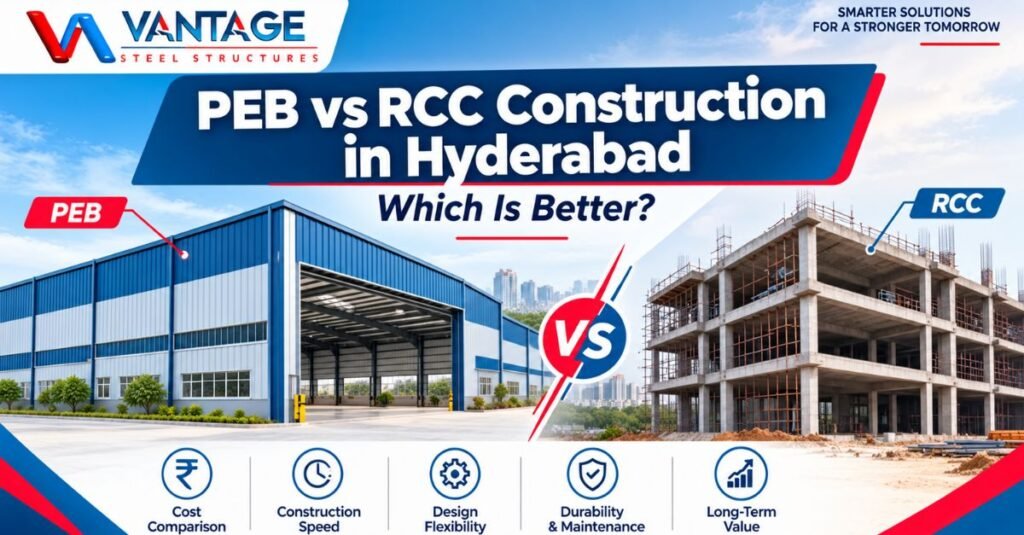
PEB vs RCC Construction in Hyderabad: Which Is Better for Your Project?
Planning a new warehouse, factory or showroom in Hyderabad? Sooner or later you face one question. Should you build with pre-engineered steel or with reinforced cement concrete?
Both methods work. Both have loyal supporters. But they suit different projects. This guide compares PEB and RCC on cost, speed, strength and flexibility, so you can pick with a clear head.
PEB and RCC: Understanding the Basic Difference
- Pre-Engineered Building (PEB): Steel members are designed and fabricated in a factory, then bolted together on site.
- Reinforced Cement Concrete (RCC): Concrete is poured on site around steel bars and left to cure.
The first method is mostly assembly. The second is mostly construction. That one difference shapes almost everything below.
PEB vs RCC Construction in Hyderabad: Key Comparison Points
Cost
RCC is often cheaper only for very small buildings. On larger industrial projects, PEB usually costs less overall. Optimised steel design cuts waste. Less site labour and a shorter schedule cut cost further. Many suppliers put the savings at around 15 to 25 per cent for a like-for-like warehouse or factory. Your result depends on design and site. Remember the full picture too: opening sooner means earlier income and less rent and interest.
Construction Speed
This is where PEB wins clearly. Parts are made while the foundation is built, so the two run side by side. A 10,000 sq. ft. warehouse often takes about 2.5 to 3 months in PEB. The same building in RCC can take six to nine months. RCC also needs curing time at each stage, and monsoon rain slows it more.
Strength and Durability
Both are strong when designed well. Steel handles long spans and wind loads with less material. RCC has excellent mass and compressive strength, which suits heavy or multi-storey structures. Steel needs good coating to resist corrosion. Concrete can crack and let in water if not maintained. Some owners worry that steel buildings feel temporary. Done well, with proper design and coating, a PEB serves for decades.
Flexibility and Future Expansion
PEB is modular. You can add bays, a mezzanine or a crane later with little disruption. RCC is harder to change. Extensions often mean breaking walls, fresh approvals and more cost.
Climate and Maintenance
Hyderabad is hot, and the monsoon is heavy. Insulated roof panels and ventilators keep a PEB cooler. Check bolts, coating and roof sheets once a year. RCC needs less attention to cladding but can face seepage and cracks over time.
Quality Control and Consistency
Factory production gives tighter tolerances. Weather does not affect fabrication. RCC quality depends on site mixing, workmanship and curing, which vary from site to site.
Sustainability
Steel is recyclable, and factory work creates less site waste. Concrete uses more water, especially during curing.
Quick Comparison at a Glance
Factor | PEB | RCC |
Build Time | Shorter | Longer |
Cost for Large Buildings | Often Lower | Often Higher |
Future Expansion | Easy | Harder |
Best Suited For | Warehouses, Factories, Showrooms | Multi-Storey, Heavy Structures |
When to Choose PEB and When to Choose RCC
There is no single winner. The right pick depends on how you will use the building.
Choose PEB For:
- Warehouses, factories, workshops and showrooms
- Wide, column-free spaces
- Tight schedules
- Plans to expand later
Choose RCC For:
- Multi-storey buildings and heavy load-bearing structures
- Very small buildings, under about 5,000 sq. ft.
- Projects that need a concrete finish
Some projects mix both. A steel warehouse can sit beside an RCC office block, for example.
A Simple Way to Decide
Ask yourself three questions. How soon do you need to open? Will the building be one storey with wide open space? Might you expand in the next five years? If you answered yes to most, PEB is likely the better fit. If you need several floors or heavy load-bearing walls, RCC or a hybrid design may suit you more. Ask for a comparison on your own drawings before deciding.
How Vantage Steel Structures Can Help
Vantage Steel Structures designs and builds pre-engineered buildings for industrial and commercial use. The company has 25 years of experience in steel construction and is ISO 9001 certified. Fabrication happens in-house at its Jeedimetla and Siddipet factories, which supports consistent quality and timelines. Its PEB solutions cover warehouses, factories, showrooms, workshops and agricultural buildings, and its completed projects show how these buildings perform in real use. The team can explain how your own project would compare under PEB, based on your size, use and site.
Conclusion
PEB and RCC are both proven methods, but they serve different needs. For warehouses, factories and showrooms, PEB usually wins on speed, cost and flexibility. RCC remains the better choice for multi-storey and heavy load-bearing structures. Compare both on your own drawings before you decide. If you would like help weighing the two for your site, you can Contact Vantage and talk to the team.